


THE PROBLEM
Today’s youth face many stressors, from social and family issues to career pressures and independence, making mental health care vital.

by
Age 24
75% all lifetime mental health conditions have begun.

1 in 5
adolescents are diagnoses with a mental or behavioral issue.

over
3.8m
young adults have had serious thoughts of suicide.
We also identified an issue with our target audience - a lot of the time, it's the people who want to help those in need that attend MHA events (parents, caregivers, friends, family), not the people in need of help.
Study found that younger age was a strong predictor of attending fewer or zero sessions in wellness groups.
PUBMED CENTRAL
Group mental health interventions had poor/highly variable attendance, especially younger and higher-symptom persons.
SCIENCE DIRECT
"Non-attendance of treatment groups in the community has been a long-standing problem in mental health care."
PUBMED CENTRAL
So how does our conference appeal specifically and directly to our target audience of stressed-out youth, instead of just those surrounding them?
OUR SOLUTION
The PAUSE Conference is for youth with unspoken mental health issues and stress to receive help, educate themselves, or simply relieve tension.
PAUSE makes mental health discussion interactive and relatable to today's youth.
Our conference will have events with the purpose of stress relief, providing impactful moments of peace to ongoers.
Workshops and events will act as both an experience and an opportunity to learn.
ANIMAL THERAPY
...is proven to reduce cortisol levels, alleviate anxiety & depression, creating a sense of emotional stability.
THE PHYSICAL ASPECT
Stress and mental sstate are linked to physical health. Exercise is a great source of dopamine and stress-relief.
EMOTIONAL REGULATION
...is important to do before stress becomes overwhelming as it helps in reducing symptoms of anxiety and depression.
USER RESEARCH


How does each competitor cater to their audience?
Are they more educational and lecture-focused or more memorable and interactive?
What is each competitor known for and why?
What sort of panels and talks are present in these organization events?
COMPETITOR RESEARCH


This research helped us figure out what kind of brand we wanted to build - how do we cater to our own young audiences and what makes us unique?
%204.png)
We then created a customer journey map to help visualize and organize our events into something logical and clear from our customer's experience - from before to after the conference.
This would also help us understand what our design deliverables would be.
%203.png)


VISUAL INSPIRATION
We then made moodboards of some of our competitors' visual identity to answer the following:
What colour schemes work for these brands, and why?
Are our competitors' brands visually energetic or relaxed?
How do the visuals for the brand help with relevancy?
Do we prioritize relevancy to the youth over our peace-based identity?
FINDINGS
VISUALS & TONE
Simple + Flat Colours
Blue + Cool Tones
Minimalist + Friendly Fonts
Subtle Gradients
Negative Space
RELEVANCY
Simple but fun and graphic visual styles that catch the eye.
Keeping up with trending aesthetics and pop culture through visuals and spokespeople.
BALANCE
We decided to prioritize our relaxing and peaceful message over visually-overt relevancy.

In the end, we went with a more relaxing, soothing visual identity, mixing gradients with minimalist graphics that play with transparency.


Our brand needed a systematic design approach to logos and visuals, so we brainstormed a set of possible assets that could be used throughout the conference.


Once we decided on a handful of icons, we then converted the sketches to usable vectors, applying our chosen visual moodboard to the designs.

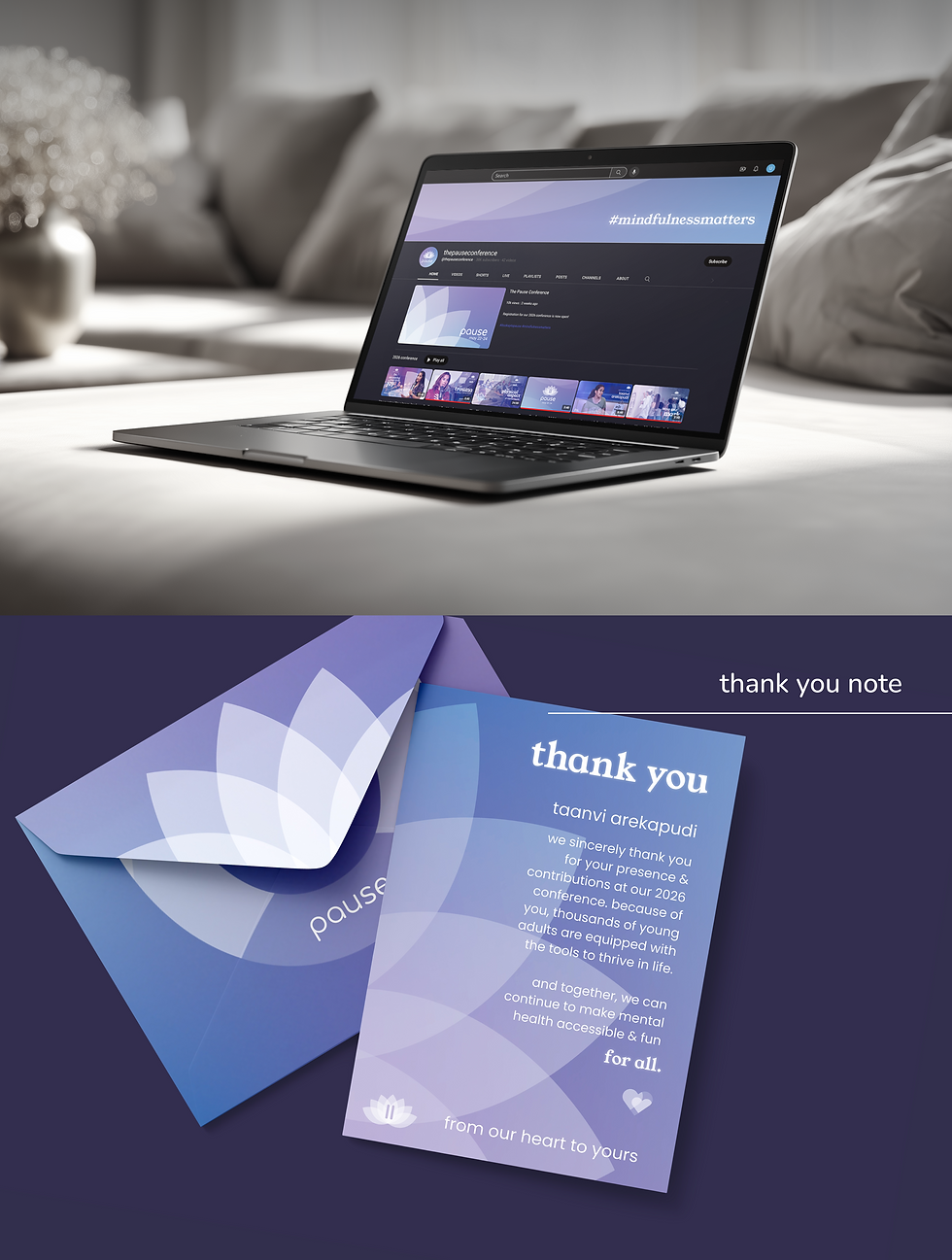
Here is the final set of mockups, following our curated customer journey - as well as the brand guidelines slide deck for our branded conference, Pause.


.jpg)
.png)


.png)
.png)
.png)

.png)
.png)


.png)
.png)
